GPR Concrete Scanning
See inside concrete before you cut, drill, or core.
See inside reinforced concrete, before you drill.
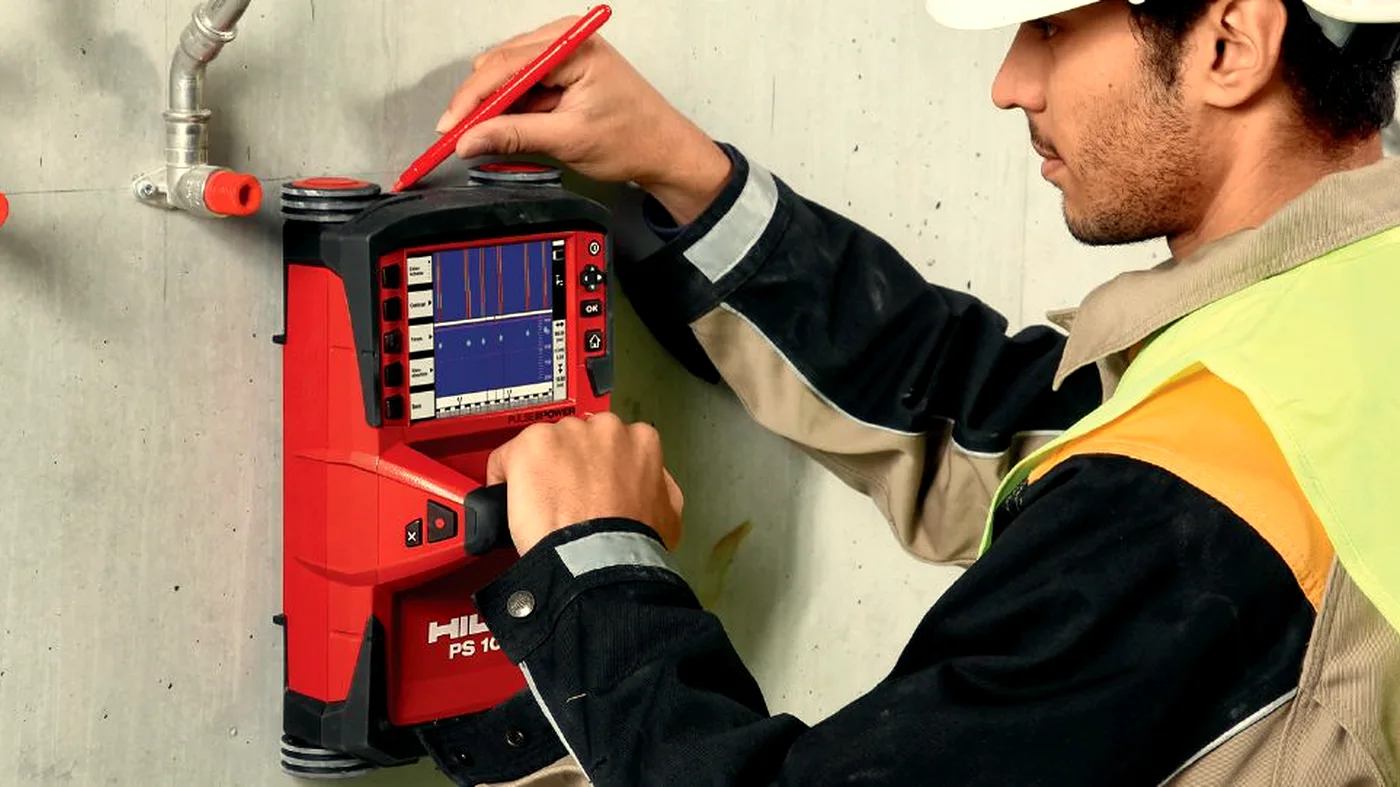
GPR concrete scanning uses ground penetrating radar to image the inside of a concrete structure non-destructively. We capture data on rebar layout, likely post-tension tendon positions, embedded conduits, voids, and slab thickness so your team can understand what the scan data indicates about embedded features within the scanned area before any work begins.
A surveyor passes a high-frequency antenna over the surface in a grid pattern. The antenna emits short electromagnetic pulses. Anything with a different dielectric to the host concrete — steel, water, voids, plastic conduit — reflects part of the signal back. Software builds a depth-indicative map of detectable reflectors and likely target positions within the scanned area. Targets are then marked up on the slab itself and supplied as a digital deliverable.
Where it helps
- Before drilling, coring, cutting or fixing
- Before structural alterations to slabs, walls, or columns
- When post-tension cables may be present
- When the original drawings are missing, incomplete, or unreliable
- Before any penetration of a structural member
- When a slab investigation, void survey, or as-built record is required
What you receive
- On-slab marker plan in survey paint or chalk
- Annotated PDF report with depths and locations
- Digital DXF / DWG plan compatible with your CAD software
- Photographs of marked-up areas
- Surveyor sign-off and method statement
A note on interpretation. GPR indicates the likely position and depth of reinforcement, services and voids within the scanned area. It does not confirm material strength or structural adequacy — structural decisions remain with your engineer.
Often surveyed together.
Ferro Scanning
Electromagnetic scanning to map reinforcement, measure cover depth, and estimate bar diameter without touching the concrete.
Learn moreConcrete Testing
On-site non-destructive and intrusive testing methods, including rebound hammer testing, pull-out testing, core extraction, and laboratory compressive strength testing.
Learn moreLarge-Scale GPR
Multi-channel and array GPR for utility mapping, highways, airfields, archaeology, and ground investigation.
Learn moreWhere gpr concrete scanning is the right tool.
Before Drilling
Locate reinforcement, post-tension cables and conduits before any drilling, coring or fixing work begins.
Learn moreStructural Assessment
Use GPR to inform structural assessment with accurate reinforcement layout and slab thickness data.
Learn morePost-Tension Cables
Identify likely post-tension tendon positions where detectable before drilling. Striking a tendon is one of the most expensive avoidable incidents on a PT slab.
Learn moreVoid Detection
GPR identifies voids, honeycombing, and delamination behind the concrete surface.
Learn moreRebar Mapping
Full reinforcement mapping with depth, spacing, and layout — delivered in CAD-ready formats.
Learn moreSlab Investigation
Slab thickness, reinforcement, and embedded items in one comprehensive scan.
Learn moreBuilt for the sectors that need it most.
GPR Concrete Scanning across the UK.
Common questions.
How long does a GPR survey take?
Half day surveys typically take 3–4 hours on site. Full day surveys allow for larger floor areas, more scan locations, or complex structures. We'll advise which is appropriate when you enquire.
When do I need to pay?
All surveys are invoiced by proforma. Full payment is required before we mobilise. We'll send the proforma invoice immediately on confirmation and works are scheduled once cleared funds are received.
How quickly will I receive the report?
Your PDF report is issued the next working day following the site visit. If you need same-day delivery, contact us to discuss.
Do your operatives have CSCS cards?
Yes. All Corvus operatives hold valid CSCS cards and carry full public liability insurance. We can provide method statements and RAMS on request.
What areas do you cover?
We cover the whole of the UK. Travel costs for sites outside London may apply — we'll confirm this when quoting.
Can you work in occupied buildings?
Yes. GPR and Ferroscan equipment is non-intrusive and silent. We regularly work in occupied offices, hospitals, and schools with minimal disruption.
Guides on gpr concrete scanning.
LPS blocks and the Building Safety Regulator: what structural evidence you actually need
Large panel system blocks are under specific scrutiny from the Building Safety Regulator. What social landlords and building safety managers need to evidence about LPS structures, and how that evidence is gathered in occupied homes.
Read articleGPR, scanning, and the Party Wall Act
Party wall work often requires investigation of the existing structure before any notifiable work begins. Here is where scanning and NDT support the party wall process.
Read articleGPR scanning in heritage and listed buildings
Non-intrusive scanning is the only sensible way to investigate the structure of a listed or historic building. Here is how GPR is used and what it can reliably find.
Read articleThe insurance case for pre-drill scanning
Drilling without a scan is not just operationally risky — it creates liability exposure that insurers are increasingly unwilling to cover. Here is what the insurance picture actually looks like.
Read articleCDM regulations and concrete scanning — the principal contractor's responsibilities
CDM 2015 places duties on principal contractors to manage pre-construction information — including the location of buried services and structural reinforcement. Here is where scanning fits.
Read articleConcrete scanning for basement conversions
What you need to know about scanning existing concrete slabs and walls before a basement conversion or underpinning project starts.
Read articleWhat engineers say about our GPR surveys
Corvus were great from start to finish. Needed a quick turnaround on a concrete survey with subsequent core hole to be drilled in a sensitive area. They attended next day and delivered their survey promptly in order for our project to stay on schedule. Highly recommend.
Fantastic experience working with Connor. He provided brilliant service, was highly efficient, and made the whole process seamless. It's rare to find someone so reliable and dedicated to quality work. 10/10 would recommend.
Contacted Corvus to use GPR to locate concrete supports laid under a porcelain patio to anchor pergolas to. Within minutes Terry called to discuss and advised they could attend within a week — with an honest caveat that it might not be possible depending on the materials. Terry and Connor attended on the agreed date, on time, and were a pleasure to deal with — professional, polite, friendly and conscientious. The majority of the footings were not where the landscaping contractors had led us to believe, so a worthwhile exercise indeed. Would thoroughly recommend.
Need a scan before you drill?
Send drawings, photos or proposed fixing locations and we'll advise the right survey approach.